Design. It is easily the most misunderstood, misrepresented and misused word in the history. Most use it as an adjective to describe their end results and products. Many also use it as a noun as if design is something they have mined and extracted. Design in its purest and most effective form is a verb. Its a unique process where you need to understand each and every atom of what you are building and question their very existence. Its is this very process that we fondly call “Design Thinking”. Lets take you through the entire process one step at a time.
The first and probably the most important step is the problem definition. Let’s say you have a problem. Instead of panicking and worrying and trying to jump at conclusion or adopting the first solution that comes to your head, sit down. Take a paper and define the problem. Question your problems, and then question those questions. Keep doing this until the questions get very awkward. Then search for your problem among those questions and pick the one that will have a broader impact. Don’t stop until your gut says, “Wow, this is it!”.
Why do this? Well, My great grandma always complained that my great grandpa took too long to come back home from the farm in his horse. To solve that he started breeding faster horses, started feeding them better and trained them harder. This only marginally improved the speed at which he used to get home and granny was still upset. Meanwhile in Germany, Karl Benz’s wife had the same complaint. He went to his garage and voila, he invented the automobile with which he could zip his way from farm to home in no time.
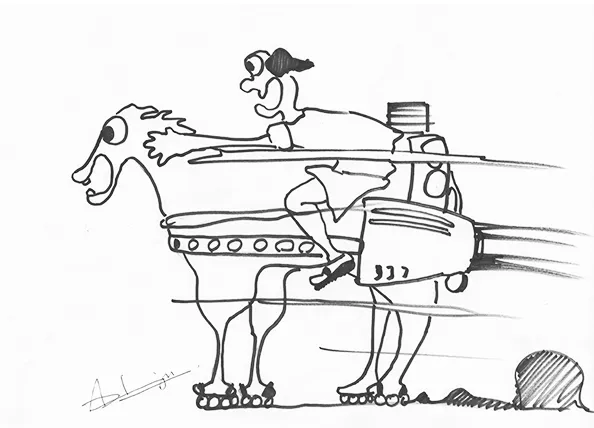
Illustration by: Abhimanyu Rajvanshi
The above story is obviously not true, but lets ponder over why my great grandpa wasn’t the one to invent the car. It’s because in his head the problem was defined as “How do I make my horse run faster?”. And that’s the problem he spent his time and effort solving. Where as Mr.Benz here, went to his garage, took a paper and sat down to define the problem. And that was when it hit him the horse was not the problem, the problem was “How can one travel faster?”
So get out of your comfort zone, step away from the light and zoom out to realise what is the problem you should be solving. Once you have understood your problem well, it no longer looks formidable and worrisome. It now becomes interesting and exciting. And this is when you see the ugly problem slowly transform into a beautiful opportunity. This is when you change the world.